
Photo: Szymon Shields on Pexels.
1. Confirm what the product actually is
Start with the statement of identity, not the largest marketing phrase. In the United States, a dietary supplement label should identify the product as a dietary supplement or use a descriptive term such as vitamin, mineral, herbal, or amino acid supplement.
Also note the form: tablet, capsule, softgel, gummy, liquid, packet, or powder. The form affects how a serving is measured and how many units you may need to take.
2. Read Serving Size before reading the dose
Every amount in the Supplement Facts panel is based on the labeled serving. A “500 mg” entry may mean 500 mg in one capsule, two gummies, a scoop, or several tablets.
Ask two questions immediately:
- How many units make one serving?
- How many servings does the container provide?
This prevents a common comparison error: comparing one product’s per-capsule amount with another product’s per-serving amount.
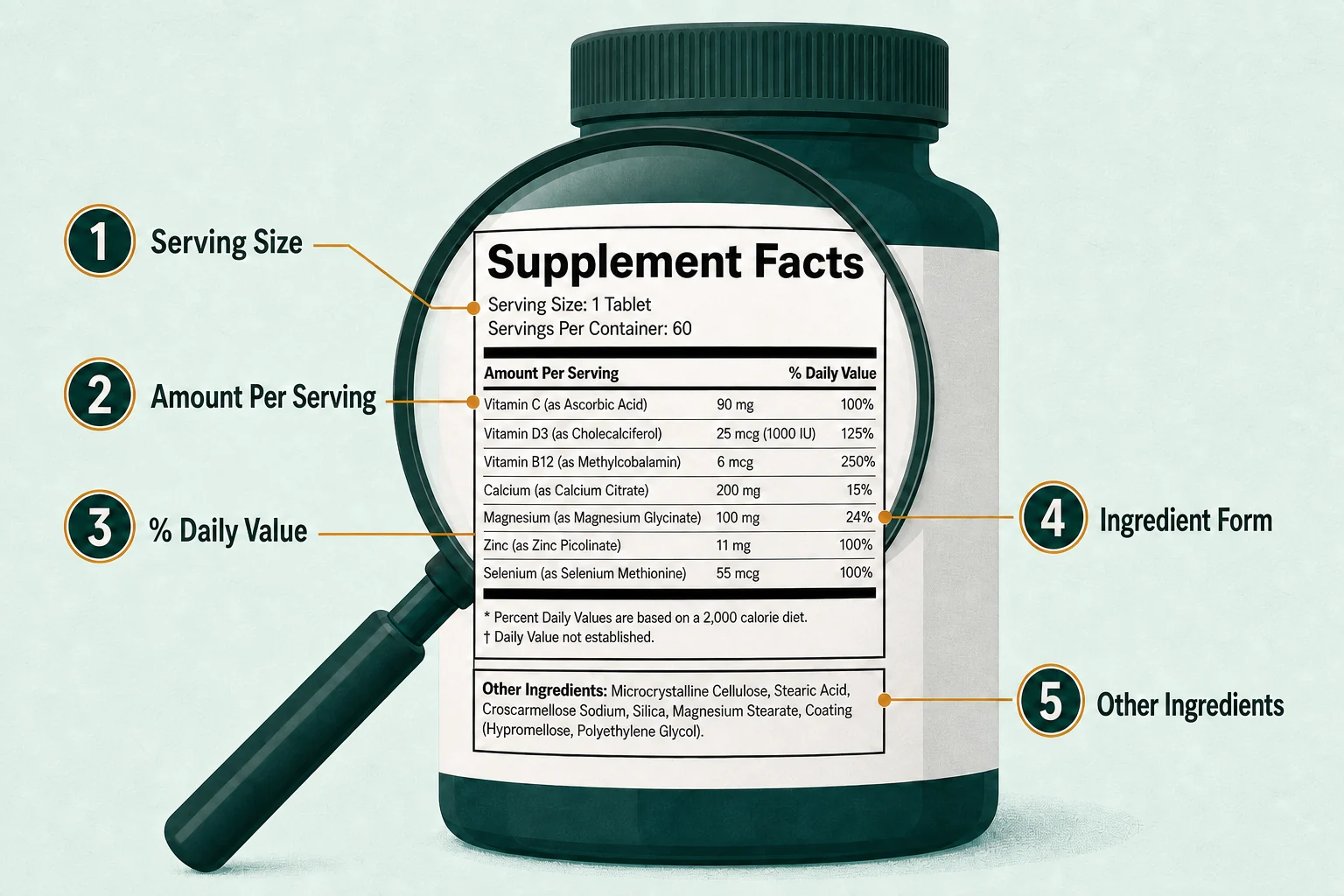
Read the panel in layers: serving first, then amounts and units, %DV, ingredient forms, and the separate Other Ingredients list.
3. Compare the amount and unit—not the front-label number
Amounts can appear in grams (g), milligrams (mg), micrograms (mcg), or nutrient-specific units such as mcg DFE for folate. Some vitamin labels also show International Units (IU).
Do not compare two numbers until the units match. A larger-looking number is not necessarily a larger amount when one label uses milligrams and another uses micrograms.
Some nutrients require additional context. Folate may use dietary folate equivalents, vitamin A may use retinol activity equivalents, and vitamin D may be shown in both mcg and IU. Use the label’s stated units and an authoritative conversion rather than guessing.
For a concrete example, see Vitamin D2 vs. D3: how to read the label. When two labels use different units, the IU to mcg converter can normalize the amounts before comparison.
4. Treat Percent Daily Value as context, not a personal dose
Percent Daily Value (%DV) shows how much one serving contributes to the FDA’s Daily Value for that nutrient. It helps standardize comparison across products.
The FDA’s general label-reading guide describes 5% DV or less as low and 20% DV or more as high. With supplements, a very high %DV is not automatically better. It also does not account for your diet, age, medicines, health conditions, pregnancy, or a clinician’s recommendation.
Read the amount and %DV together. They answer related but different questions.
5. Notice when Daily Value is not established
Herbs, amino acids, extracts, and other dietary ingredients may not have an established Daily Value. A symbol in the %DV column commonly points to a note explaining this.
“Daily Value not established” is not evidence that an ingredient works, does not work, is safe, or is unsafe. It only describes its Daily Value status.
For these ingredients, comparisons depend more heavily on the actual amount, ingredient identity, form, relevant research, and intended use.
6. Read the ingredient form and source
The nutrient name is only the first layer. The text in parentheses may identify the source or compound—for example, the particular form supplying a mineral.
When comparing products, record the full line:
- nutrient or ingredient name;
- source or form;
- amount per serving;
- %DV, if established.
Avoid assuming that one form is universally “best.” Evidence, tolerability, dose, formulation, and the reason for taking the supplement all matter.
7. Look closely at proprietary blends
A proprietary blend can list the total weight of the blend and its components without disclosing the amount of every component. Under FDA labeling rules, the components must be listed in descending order of predominance by weight within the blend, but that order does not reveal exact individual doses.
That makes it harder to compare the product with another label, a study, or professional guidance. Treat a hidden amount as missing comparison information—not as proof that the blend is ineffective or unsafe.
8. Do not skip Other Ingredients
The ingredients outside the Supplement Facts panel may include capsule materials, fillers, binders, colors, flavors, sweeteners, coatings, stabilizers, and preservatives.
Check this list when you care about:
- allergies or intolerances;
- vegan or vegetarian capsule materials;
- gluten, soy, or other dietary preferences;
- added sugars or sweeteners;
- colors, flavors, and processing ingredients.
Also check allergen statements and any advisory facility warnings elsewhere on the package.
9. Separate regulated label facts from marketing claims
Front-label phrases such as “high potency,” “natural,” “clean,” “supports immunity,” or “maximum absorption” are not substitutes for the Supplement Facts panel.
Nutrient-content and health-related claims have specific regulatory categories, but a polished claim still does not prove that a product is the right choice for you. Be especially cautious with language suggesting that a supplement diagnoses, treats, cures, or prevents disease.
The FDA does not approve dietary supplements for safety and effectiveness before they are sold. A label can help you identify what the manufacturer declares; it cannot independently verify the contents.
10. Read directions, warnings, and the whole package
The Supplement Facts panel is only one part of the label. Review:
- directions and timing;
- age restrictions;
- pregnancy or breastfeeding warnings;
- medication and condition warnings;
- storage instructions;
- manufacturer or distributor details;
- lot and expiration information when provided.
Supplements can interact with medicines and with each other. If a decision depends on a diagnosis, laboratory result, pregnancy, a health condition, or medication use, discuss the complete label with a qualified healthcare professional.
A 30-second vitamin-label checklist
Before buying or taking a product, confirm:
- The product type and dosage form.
- The number of capsules, gummies, scoops, or drops per serving.
- The amount and unit for each relevant ingredient.
- The %DV and whether a Daily Value exists.
- The complete ingredient form or source.
- Any proprietary blend with undisclosed individual amounts.
- The Other Ingredients and allergen information.
- Directions, warnings, and storage instructions.
- Whether front-label claims match the detailed panel.
- Whether anything needs professional review.
For older or hard-to-find products, the NIH Dietary Supplement Label Database can help locate label images and declared ingredient information. Formulas can change, so compare any database entry with the package currently in your hand.
If you are unsure which facts panel you are looking at, start with Supplement Facts vs. Nutrition Facts.