
The short answer
In the United States, Nutrition Facts is the nutrition panel used on conventional packaged foods and drinks. Supplement Facts is the nutrition panel used on dietary supplements such as vitamins, minerals, herbs, amino acids, and many capsules, tablets, powders, and gummies sold as supplements.
The panels look related because both can show serving information, amounts, and Percent Daily Value. But they follow different rules and answer different questions.
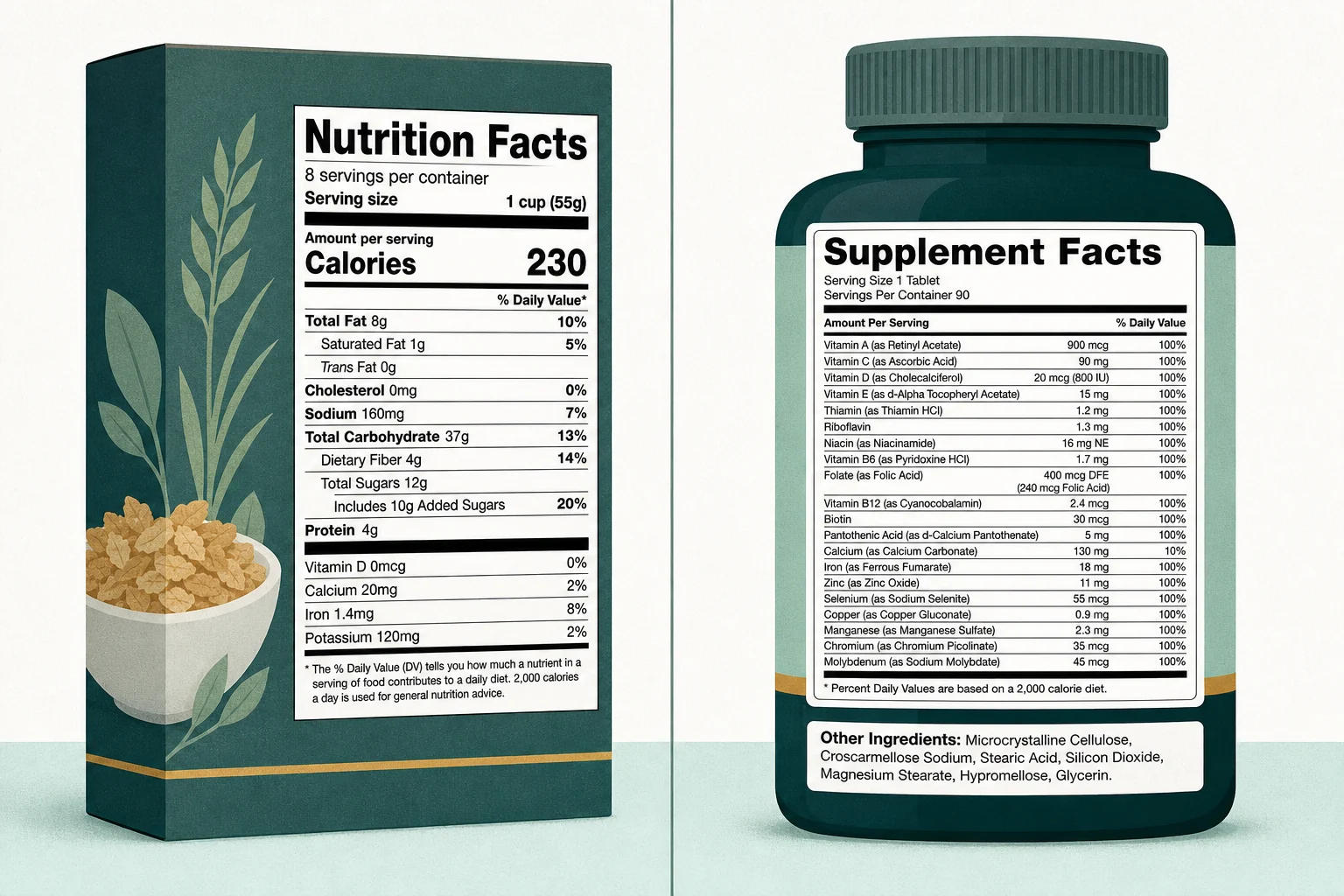
The headings look similar, but the panels describe different product categories and disclose different kinds of information.
| Question | Nutrition Facts | Supplement Facts |
|---|---|---|
| What is it for? | Conventional foods and beverages | Dietary supplements |
| What leads the panel? | Serving size and calories | Serving size and servings per container |
| Can it list dietary ingredients without a Daily Value? | Not as dietary ingredients in the Nutrition Facts panel | Yes |
| Can it identify the source of a dietary ingredient? | Not in the same way | Yes—for example, a mineral compound may appear after the nutrient name |
| Can it identify a botanical and plant part? | Not in the Nutrition Facts format | Yes, when applicable |
| Can zero amounts appear? | Required for certain nutrients | Zero amounts are not permitted in the Supplement Facts panel |
Nutrition Facts describes a food as food
The Nutrition Facts label is built around the nutritional composition of a food or beverage. It commonly lists calories, total fat, saturated fat, sodium, total carbohydrate, dietary fiber, total sugars, added sugars, protein, and required vitamins and minerals.
Its serving size gives the reference amount for every number that follows. If you consume two labeled servings, you generally need to multiply the calories and nutrient amounts by two.
The FDA’s general guide for interpreting Percent Daily Value is:
- 5% DV or less per serving is considered low.
- 20% DV or more per serving is considered high.
That shortcut can help compare similar foods, but it does not turn the panel into a personalized diet plan.
Supplement Facts can include ingredients with no Daily Value
A Supplement Facts panel must identify the dietary ingredients in the product and state their amounts per serving. It can also include ingredients for which the FDA has not established a Daily Value.
When no Daily Value exists, the %DV column may use a symbol that points to a note such as “Daily Value not established.” This does not mean the ingredient has been proven effective or ineffective. It only means there is no established Daily Value for that ingredient.
This is one of the most useful differences between the two panels. A supplement might contain a vitamin with a %DV, a mineral with a %DV, and a botanical extract without one—all in the same Supplement Facts box.
Supplement labels can show sources, forms, and plant parts
Supplement Facts may give more identity detail after an ingredient name. A label might show a mineral followed by its compound or source, such as a form of magnesium in parentheses. Botanical ingredients may include the plant name and the part used, such as root, leaf, or seed.
That wording matters when comparing two products that advertise the same headline ingredient. “Magnesium” on the front of a bottle is less specific than the full entry in the Supplement Facts panel. Likewise, two botanical products may not be directly comparable if they use different plant parts, extraction descriptions, or amounts.
Read our magnesium label guide for a closer look at how nutrient forms appear on supplement labels.
Serving size works differently from a dose recommendation
On a Supplement Facts label, serving size establishes the amount represented by the numbers in the panel. FDA guidance ties supplement serving size to the maximum amount recommended on the label for one eating occasion—or one unit when no recommendation is given.
That does not make the serving size a personalized recommendation. Age, pregnancy, health conditions, medicines, laboratory results, and total intake from foods and other supplements can all change what is appropriate for an individual.
Always compare three separate pieces of information:
- Serving Size in the facts panel.
- Directions elsewhere on the package.
- Your actual intake across the day.
A bottle can say “1,000 mg per serving” while one serving requires two or four capsules. The large front-label number alone does not tell you the per-capsule amount.
Other Ingredients sits outside the Supplement Facts panel
The Supplement Facts box focuses on dietary ingredients. Capsule shells, binders, fillers, flavors, colors, sweeteners, coatings, and similar nondietary components commonly appear in a separate Other Ingredients list.
That separate list can matter for allergies, vegan preferences, sweeteners, capsule materials, and additives. A supplement is not fully described by the bold facts panel alone.
Neither panel is a seal of approval
A required label format does not mean the FDA approved a product before sale. The FDA says it does not approve dietary supplements for safety and effectiveness before they reach the market. Supplement companies are responsible for ensuring that products and labeling meet applicable requirements.
The label also cannot confirm purity, contamination, authenticity, or whether the product is suitable for you. It is a structured starting point for comparison—not a substitute for product testing or medical advice.
A quick way to tell which label you are reading
Use the heading first:
- Nutrition Facts usually means you are looking at a conventional food or beverage.
- Supplement Facts means the product is marketed as a dietary supplement.
- Drug Facts is a different format used for over-the-counter medicines, not dietary supplements.
Then check whether the product identity matches the panel. A supplement label should identify the product as a dietary supplement or with a descriptive term such as vitamin, mineral, or herbal supplement.
How to compare two products accurately
Before comparing numbers, make the labels comparable:
- Match the serving sizes.
- Convert amounts to the same unit when appropriate; for vitamins D, A, and E, use the IU to mcg converter.
- Separate amount per serving from %DV.
- Compare ingredient forms and sources, not only nutrient names.
- Check ingredients without an established Daily Value.
- Read the Other Ingredients list.
- Review directions and warnings outside the facts panel.
For a complete walkthrough, continue with how to read a Supplement Facts label.