
Start with the same unit and the same basis
Comparing “1,000 IU” with “50 mcg” is not enough. The first number might describe one softgel; the second might describe two gummies.
For vitamin D, 1 mcg = 40 IU. That makes 1,000 IU equal to 25 mcg, and 2,000 IU equal to 50 mcg. This factor is specific to vitamin D; do not use it for vitamins A or E. NIH conversion reference
Then check Serving Size. The FDA distinguishes the required per-serving information from an additional per-unit declaration. If you want to compare one gummy with one softgel, you may need one more calculation. FDA labeling guide
Three real labels
We checked the manufacturers’ U.S. product pages and published label images on September 4, 2026. These are examples of label arithmetic, not a ranking or a recommendation to take any of the products. We did not test their contents in a laboratory.
| Product | Labeled serving | Vitamin D per labeled serving |
|---|---|---|
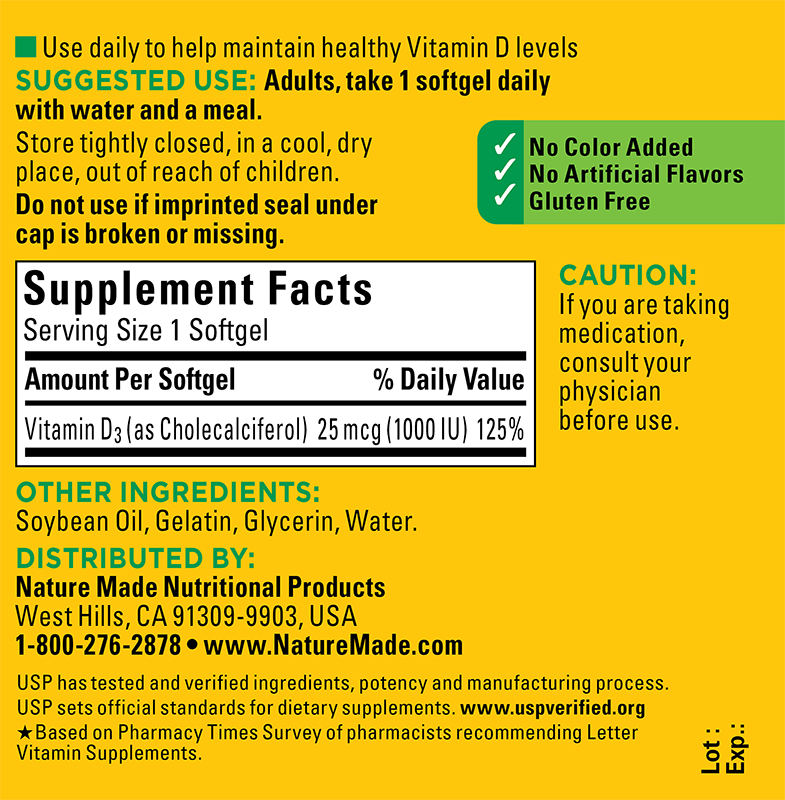
| Nature Made D3 1000 IU Softgels | 1 softgel | 25 mcg (1,000 IU) |
| Nature Made Zero Sugar D3 Gummies | 2 gummies | 50 mcg (2,000 IU) |
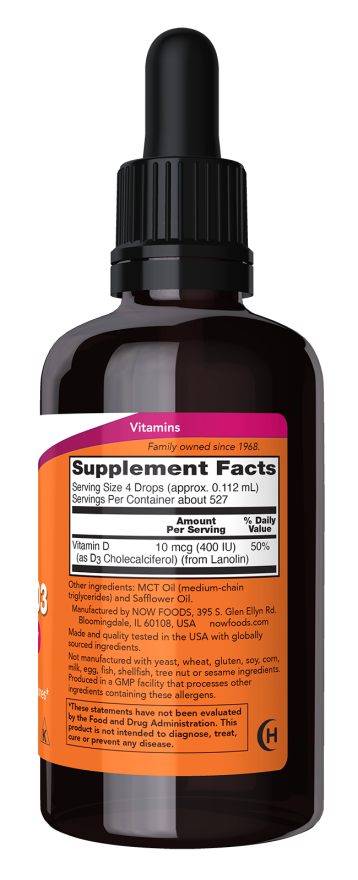
| NOW D3 Liquid, regular strength | 4 drops | 10 mcg (400 IU) |
The serving sizes and amounts above come from the published labels. The per-unit amounts below are our calculations from those declarations, not measurements of individual pieces or drops.
1. The softgel: no serving-size division needed
The Nature Made softgel label specifies one softgel and 25 mcg of vitamin D3. Here, the amount per serving is also the amount per softgel:
25 mcg × 40 = 1,000 IU per softgel.
There is a useful source-checking detail: when we reviewed the product page, one descriptive sentence paired 1,000 IU with 50 mcg. The published Supplement Facts image and the page’s ingredient amount both said 25 mcg. We used the label, which agrees with the conversion—not the inconsistent sentence. This does not establish a problem with the product itself.
2. The gummies: the larger number covers two pieces
The Zero Sugar gummy label declares 50 mcg, or 2,000 IU, for two gummies.

To express that declaration per gummy:
50 mcg ÷ 2 = 25 mcg = 1,000 IU per gummy.
So one gummy and one softgel have the same calculated vitamin D amount per piece in these examples. But the full labeled gummy serving contains twice as much as the full labeled softgel serving. Both statements can be true.
That arithmetic does not mean you should replace one product’s directions with another’s, or change the number you take.
3. The liquid: four drops are not one drop
The regular-strength NOW label gives 10 mcg, or 400 IU, for four drops.
10 mcg ÷ 4 = 2.5 mcg = 100 IU per drop.
Reading 400 IU as the amount in each drop would overstate this product’s declared concentration fourfold. This calculation applies to this specific regular-strength product and its labeled drop measure. Do not transfer it to another liquid or assume a full dropper equals one drop.
Where milligrams fit
There are 1,000 micrograms in a milligram. Divide mcg by 1,000 to express the same amount in mg.
| One unit of the product | Calculated vitamin D amount in matching units |
|---|---|
| 1 Nature Made softgel | 1,000 IU = 25 mcg = 0.025 mg |
| 1 Nature Made Zero Sugar gummy | 1,000 IU = 25 mcg = 0.025 mg |
| 1 drop of regular-strength NOW liquid | 100 IU = 2.5 mcg = 0.0025 mg |
The mg figures are our conversions; they are not additional amounts to add to the mcg figures. These numbers describe vitamin D, not the total weight of a softgel, gummy, or liquid drop.
Use the IU to mcg and mg converter to check the arithmetic: select Vitamin D, enter 1,000 IU, and switch between mcg and mg. The result is 25 mcg or 0.025 mg. To reproduce the liquid example, enter the calculated 100 IU per drop. The converter changes units; it does not work out the serving size for you.
Apply the same check to your bottle
- Match the exact product and strength, not just the brand name.
- Read the serving size and the vitamin D amount together.
- Decide whether you are comparing a full serving or one unit, and keep that basis consistent.
- Divide by the number of pieces or drops only when calculating a per-unit amount, then convert the units.
- Read the form, other ingredients, directions, and warnings separately. Equal vitamin D amounts do not make two products identical.
Labels can change and differ by market. If your bottle disagrees with an online listing, use the exact bottle and ask the manufacturer to clarify the discrepancy. A calculated amount is not a personalized dose or proof of product quality.
For the broader context, see vitamin D2 vs. D3 on supplement labels and how to read the rest of a Supplement Facts panel.